







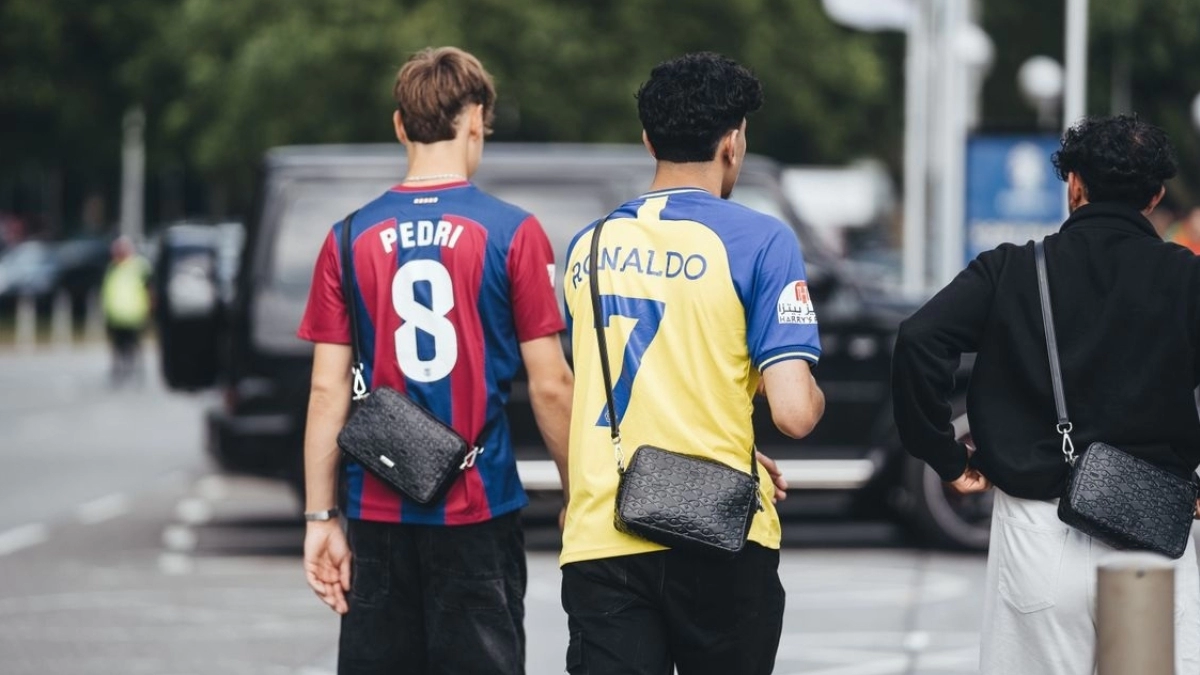
Not long ago, the most coveted fashion catwalks in the world were in Paris, Milan, or New York. However, now they seem to be moving to a much more unexpected place: the dressing room tunnels of the world's major stadiums. Gone are the days when professional footballers wore identical tracksuits or sober tailored suits before a crucial match. Today, the players' arrival at the venue is a media spectacle in its own right. A mandatory prelude where street style photographers crowd as eagerly as sports reporters.
The metamorphosis of the footballer: from athlete to global fashion icon
This phenomenon did not happen overnight but is the result of a cultural and commercial evolution that began in the late 20th century in the United States, with Allen Iverson, an NBA player, being one of the first proponents. In football, the great pioneer is considered to be David Beckham, who sowed the seed of the footballer paying attention to aesthetics and challenging the stereotypes of the time. Often with a simple gesture like switching shirts for polos.
Currently, this mindset has been normalized and exponentially multiplied thanks to the power of social media. Platforms like Instagram and TikTok have allowed players to show their personality unfiltered, sharing their daily outfits and favorite brands with millions of followers who seek to imitate their way of dressing.
The diversification of footballers' wardrobes is astonishing, combining the comfort of high-end sportswear with the sophistication of contemporary design, creating a perfect balance between classic elegance and urban dynamism. This versatility has captured the attention of fast fashion brands and luxury giants alike, companies that see in them the perfect vehicle to connect with the new generations of consumers.
A paradigm shift
The economic impact of this transformation is undeniable. The most exclusive fashion houses in the world, which previously viewed the world of football with some distance and superiority, now fiercely compete with each other to dress the big stars.
Million-dollar sponsorship agreements, capsule collections designed in collaboration with the players themselves, and entire fashion shows inspired by football aesthetics are now the norm, consolidating a strategic alliance where sport brings epic and passion, and fashion offers status and lifestyle.
The dressing room tunnel is the new catwalk
Top-level clubs like Paris Saint-Germain, Real Madrid, Arsenal, or Manchester City have understood perfectly that their players' image off the field is a brand asset of great value. Therefore, the interior corridors of the stadiums, once shadowy and purely functional areas, now have lighting specifically designed to capture every detail of the pre-match looks, as if they were huge photographic studios.
These impromptu catwalks generate massive digital traffic. In fact, there are social media accounts whose sole purpose is to analyze the players' clothing. The millions of interactions they accumulate in a matter of minutes are the best proof of the interest generated.
In this space, luxury streetwear reigns with absolute authority. Hoodies from luxury brands, limited edition sneakers, and personalized leather jackets coexist with unimaginable accessories. The modern footballer is not afraid to experiment with bold silhouettes, vibrant colors, or daring prints, breaking the molds of conventional masculinity and demonstrating a very attractive self-confidence to the young audience.
However, what is truly interesting about this trend is how it democratizes access to fashion. Although it is true that the individual pieces they wear can cost thousands of euros, the way they structure their outfits (for example, playing with layers, sports shoes, and oversized garments) is easily replicable by fans acquiring much more affordable items.
The ripple effect: how fans adopt football aesthetics
The influence of footballers on street style has created a global aesthetic trend known popularly as blokecore. This trend involves integrating retro or contemporary football shirts into daily outfits, combining them with jeans, tailored pants, or designer skirts.
What started as a manifestation of loyalty to a club has evolved into a universal dress code adopted by celebrities, models, and fashion enthusiasts who may have never watched a full match but recognize the visual power of sports iconography.
Footballers are the main drivers of this movement. By seeing them combine high-performance technical garments with fine tailored pieces on their official trips or days off, the public has lost the fear of mixing formal and informal styles. Comfort has become the central foundation of the modern wardrobe, and understandably, no one understands better how to manage comfort under media pressure than an elite athlete.
A transformation that transcends borders
By now, it is clear that footballers have ceased to be mere performers of a sport to become the creative directors of contemporary popular culture. In fact, their ability to transition naturally between the rigor of daily training and the sophistication of international catwalks has redefined the concept of celebrity.
By taking over street style, they have not only enriched the fashion industry with their vitality and diversity but have also demonstrated that true style knows no borders, inseparably uniting fan passion with street elegance.
This news is an automatic translation. You can read the original news, Del vestuario al street style: cómo los futbolistas marcan tendencia fuera del campo
-
 22 Oct 2026 | 15:00David Raya sends a 'message' to Real Madrid
 -
 22 Oct 2026 | 16:00PSG can now sign Kvaratskhelia's replacement
 -
 22 Oct 2026 | 13:00Mourinho's blacklist at Real Madrid grows, three names already on it
 -
 22 Oct 2026 | 10:00Nico Paz embarrasses Real Madrid again
 -
 22 Oct 2026 | 12:00The center-back that Barcelona rejected in the summer, now shines
 -
 22 Oct 2026 | 09:00Vinicius is no longer embarrassing
 -
 22 Oct 2026 | 14:00Scaloni leaves Florentino Pérez standing
 -
 22 Oct 2026 | 02:00Real Madrid Keeps Track of Johan Manzambi
 -
 22 Oct 2026 | 17:00Marcelino, option for Manchester United's bench
 -
 22 Oct 2026 | 13:00Braulio Vázquez speeds up Valencia's first signing for January
 -
 22 Oct 2026 | 09:00Turmoil at Manchester United: Bruno Fernandes lashes out at Michael Carrick
 -
 22 Oct 2026 | 11:00Arsenal complicates a signing for Atlético and Barcelona
 -
 22 Oct 2026 | 17:00The Champions League's top scorer is being courted by Atlético Madrid